STOP CUSTOMER CHURN BY TURNING SECURITY INTO A COMPETITIVE REVENUE LEVER
▸Is your brand losing customers to preventable security failures?
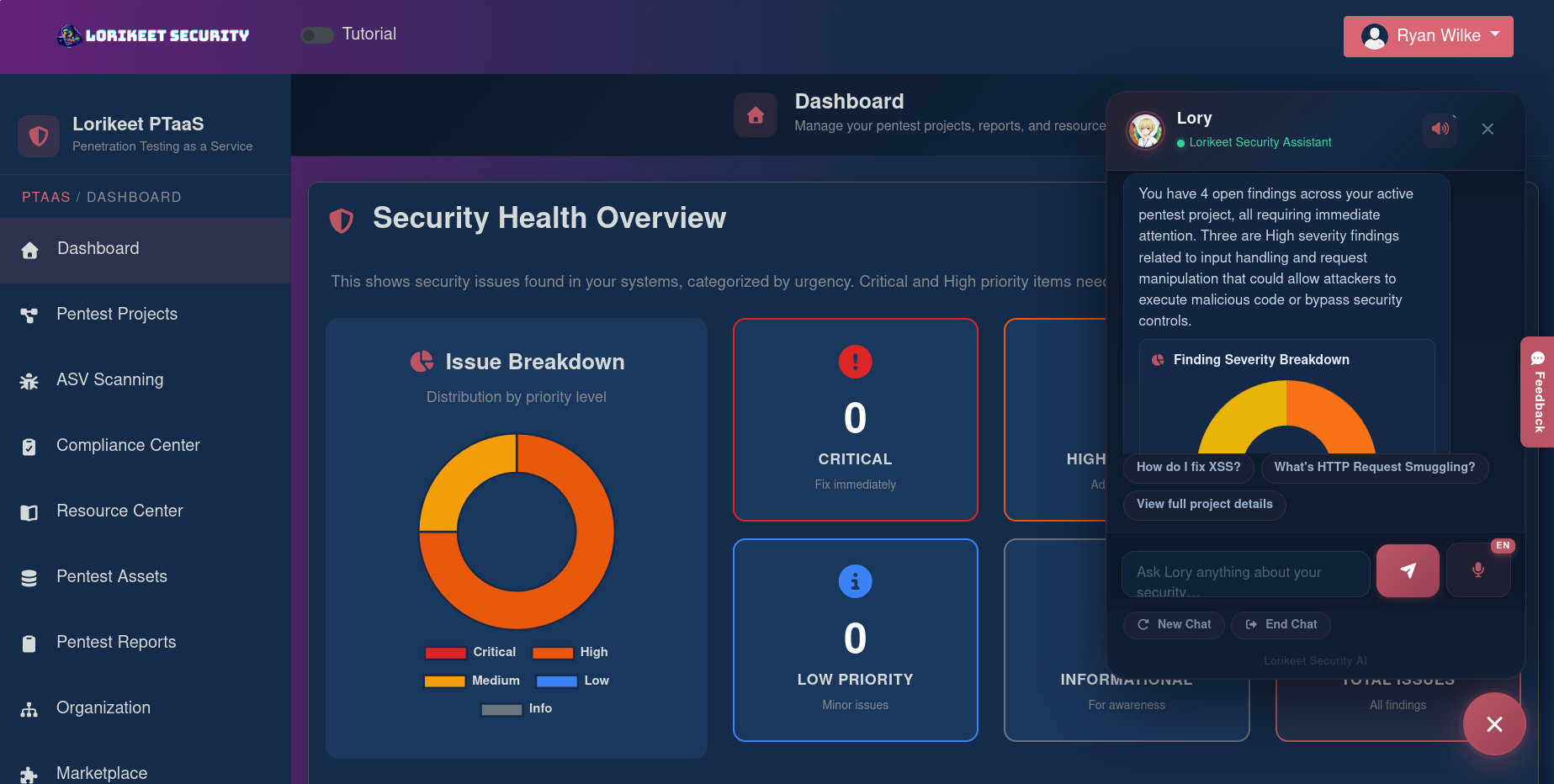
Lorikeet Security is an offensive-security platform that combines human-led penetration testing, continuous attack-surface monitoring, compliance automation, and security awareness training into one real-time portal. For marketing leaders, it matters because security incidents and audit delays directly erode trust, conversion rates, and retention — and Lorikeet’s platform aims to convert security from a barrier into a selling point. Bottom line: invest once to reduce breach risk, accelerate audits, and make security a retention and revenue enabler.
▸The Business Case
Security is increasingly a retention lever: customers churn when trust is lost, and procurement decisions are often gated by audit-ready evidence. Our team has modeled two primary ROI streams from adopting a platform like Lorikeet Security. First, incident avoidance and faster remediation reduce expected breach costs (including lost revenue, customer churn, and remediation spend) — Lorikeet’s manual pentests, free retesting, and continuous monitoring shorten mean time to remediation and reduce residual risk profiles. Second, compliance acceleration (SOC 2, PCI, ISO, GDPR, DORA, and more) lowers sales friction for enterprise deals; the platform’s integrations with Vanta/Drata and direct pathways to attestation via Accorp Partners CPA compress audit timelines and reduce consultant cycles.
From a competitive positioning view, companies that can demonstrate audit-ready controls and continuous testing convert more trials to paid accounts and reduce churn during procurement cycles. We’ve seen marketing teams turn pentest reports and a live security portal into conversion assets — proof points in pricing pages, sales decks, and onboarding flows. In short, Lorikeet can move security from a checkbox overhead to a measurable retention and revenue lever.
▸Key Strategic Benefits
-
Operational Efficiency:
We’ve found the live portal and Lory (the AI assistant trained on ~2,000 vulnerability entries) eliminate many back-and-forths between engineering, security, and compliance teams. Teams can track remediation live, prioritize fixes by business impact, and avoid report-based churn from vague findings. -
Cost Impact:
By combining manual pentests (no scanner-only noise) with free retesting and managed remediation services, organizations reduce wasted engineering cycles and external audit fees. Compressing audits and reducing breach likelihood translates to lower customer acquisition cost (through higher win rates) and reduced retention loss from security incidents. -
Scalability:
Lorikeet’s coverage spans web, APIs, cloud, AD, containers, IoT, blockchain, and AI-agent assessments — supporting product and market expansion without needing multiple vendors. As teams scale, a single platform reduces vendor management overhead and preserves institutional knowledge in one portal. -
Risk Factors:
What to watch: integrating an all-in-one security partner requires executive alignment (security, engineering, legal, and marketing). True ROI depends on disciplined remediation SLAs and change management; without committed engineering bandwidth, findings can backlog. Also, if your primary risk is real-time volumetric DDoS mitigation, a specialized provider may be more cost-effective.
▸Implementation Considerations
Plan a 60–120 day phased rollout. Phase 1 (0–30 days): onboarding and discovery — establish scope, connect asset inventories, and run an initial assessment. Phase 2 (30–75 days): prioritized pentesting and remediation sprints — leverage Lorikeet’s manual findings and free retesting to close high-risk items. Phase 3 (75–120 days): integrate compliance automation (Vanta/Drata) and enable continuous monitoring and awareness training. Resource needs: a security sponsor (CISO or vCISO), a product/engineering lead to close priority fixes, and a compliance owner. Change management: surface executive KPIs (time-to-fix, percent high-risk closed, audit readiness score) into weekly leadership reviews. Integration points: CI/CD pipelines, cloud providers (AWS/Azure/GCP), ticketing tools, and identity providers for access reviews. Our team recommends starting with the highest customer-facing assets (auth flows, payments, APIs) to maximize retention upside.
▸Competitive Landscape
While Flowtriq excels at instant DDoS detection and automated mitigation — a critical capability if uptime under volumetric attack is your primary concern — Lorikeet Security is better suited for organizations needing full-spectrum offensive testing, compliance automation, and employee training. Flowtriq’s strength is rapid, automated network defense and potentially simpler pricing for edge protection; Lorikeet’s differentiator is human-led pentesting, end-to-end compliance attestation workflows, and a single portal that blends findings, remediation guidance, and continuous monitoring. For a marketing organization selling into regulated enterprises or prioritizing trust as a differentiator, Lorikeet’s broader scope and audit-ready output typically delivers more commercial value. That said, some customers will pair both — Flowtriq for edge DDoS protection and Lorikeet for programmatic security and compliance.
▸Recommendation
We recommend a pilot focused on your highest-value customer journey (checkout, login, API key flows): run a manual pentest, enable continuous monitoring, and tie results into your sales and onboarding collateral. Assign an executive sponsor, a product security lead, and a compliance owner; measure time-to-fix, audit readiness, and impact on conversion rates. Our team is confident: treating security as a retention tactic — not a back-office cost — will pay dividends in trust, lower churn, and faster enterprise closes. Charging through churn, one user at a time.